Product Owners
Explain the users, business processes and consequences that make a failure important.
For Project Teams
Turn what Product Owners, developers and testers know about the product into a clear starting point for testing. See what deserves the most attention, how deeply to test it and which techniques may help - then carry that structure into the tools where the team does the actual work.
The team problem
Product Owners know which behaviour matters to customers. Developers know which integrations and technical areas are fragile. Testers often receive requirements, tickets, old test cases and conversations, then have to reconstruct the testing priorities themselves.
RiskRover records the team’s decisions against the product structure, so testers can see what matters and why before they design cases instead of searching tickets, documents and meeting notes for the answer.
One person can capture these decisions on Free. Work together in RiskRover with Pro.
Team workshops
Use Product Risk Analysis as the working surface for a live discussion that can expose assumptions quickly. Capture product areas, quality concerns, impact and likelihood once, then reuse those decisions when defining testing depth and techniques. Teams can also contribute asynchronously or start with one knowledgeable person and invite review; RiskRover does not require a formal workshop.
Team perspectives
The assessment becomes stronger when each role adds the context it actually knows.
Explain the users, business processes and consequences that make a failure important.
Add technical fragility, dependencies, change concentration and delivery constraints.
Bring testing knowledge, uncertainty, relevant quality concerns and practical testability.
Keep scope, timing, capacity and stakeholder commitments visible when trade-offs are made.
Practical prioritisation
Not every product area needs the same attention. RiskRover makes deliberate differences visible before testers start designing cases; the examples below depend on the risk discussion and agreed strategy, not a universal testing recipe.
A new payment integration with serious business impact may justify deeper integration, negative and recovery testing.
An important changed workflow may need deliberate functional and boundary coverage without the depth of a critical integration.
A low-impact administration screen can receive proportionate checks instead of consuming the same capacity as critical functionality.
Performance may matter most for checkout while security-focused techniques may deserve more attention around authentication.
For testers
A tester should not have to start every feature with a blank page and ask which techniques might help. Each strategy row shows the product area, quality concern, risk class and agreed intensity. RiskRover can then suggest editable strategy text from active techniques configured for that intensity.
Set an intensity for each product area and quality concern to show how much dedicated testing attention it needs: none, light, focused or deep.
RiskRover suggests editable strategy guidance; it does not generate finished test cases.
Workshop to execution
The workshop output stays useful after the meeting because each handoff reuses the information already captured.
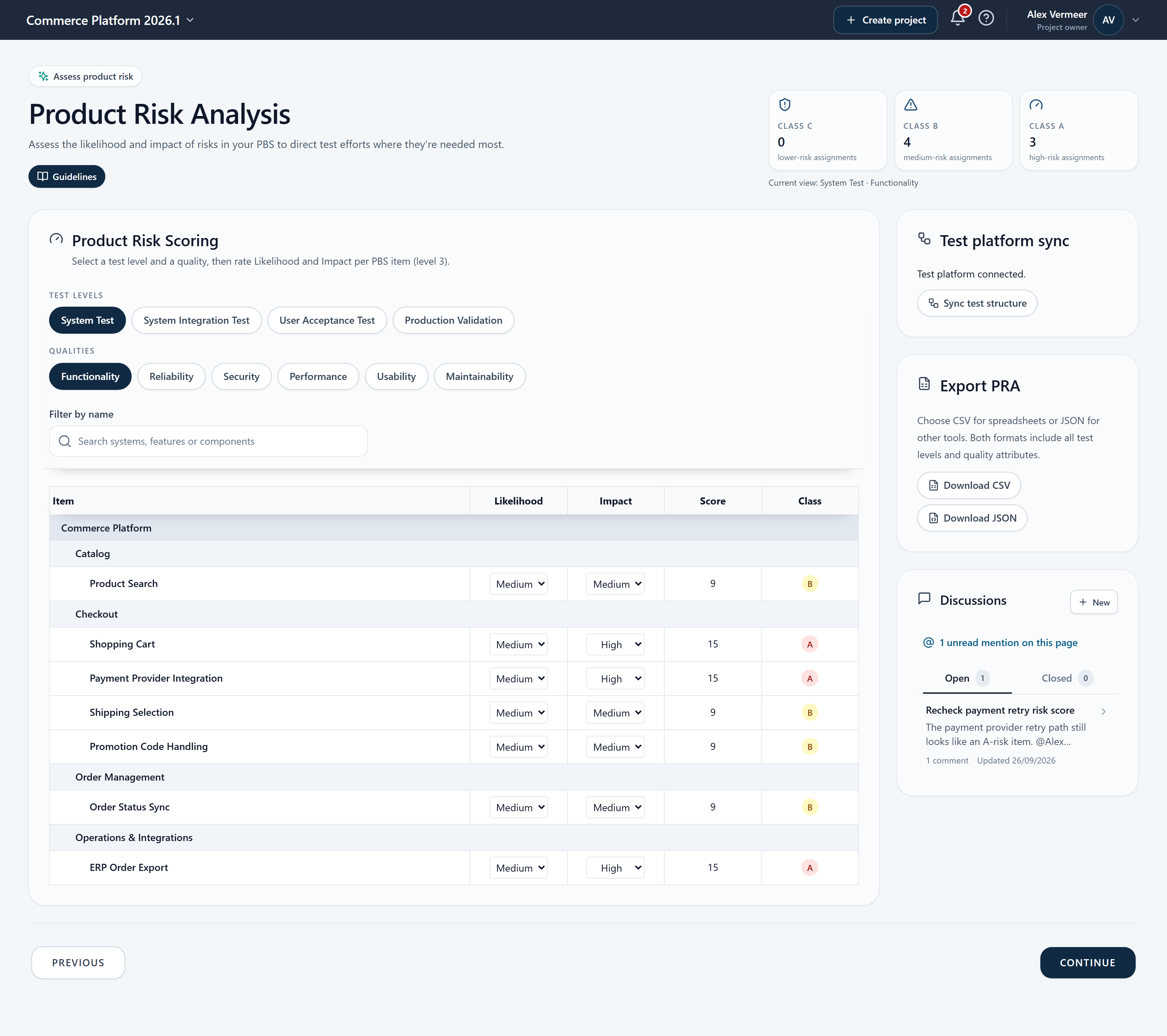
Product Owners, developers and testers contribute what they know about behaviour, failure and fragility.
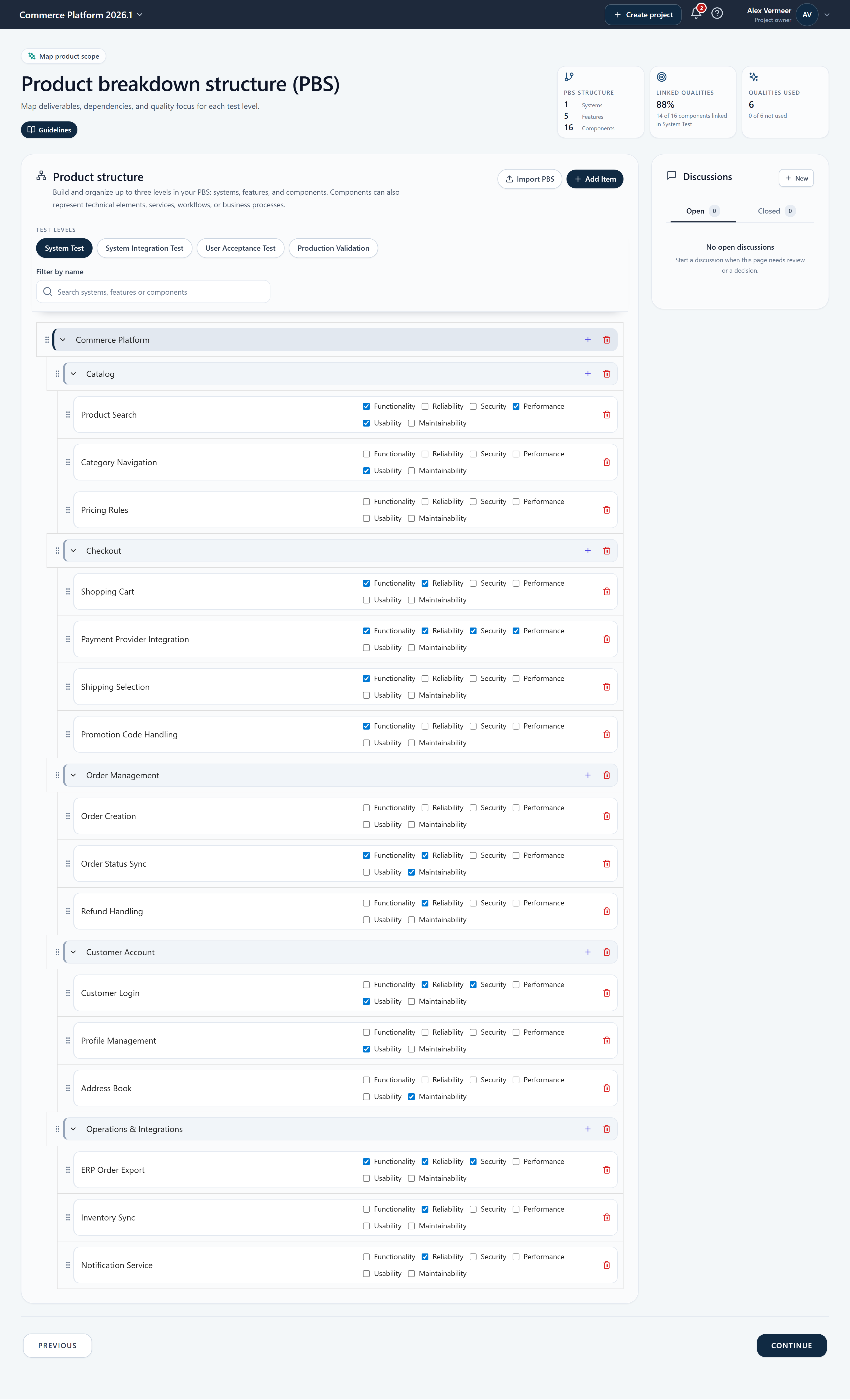
Organise that knowledge into test levels, product areas, detailed components and relevant qualities.
Record impact and likelihood so the team can see where failure matters most.
Turn risk into agreed intensity, editable strategy guidance and techniques to consider.
Configure Plan-based, Delivery-based or Mixed execution and reuse the hierarchy in Activities, Work Items and supported test repositories.
Capture Test Attention and review Strategy Coverage at Milestones alongside shared Test Readiness and Journal history.
Practical reprioritisation
A new external interface appears late, a feature leaves the release or the deadline moves forward. The existing test work should not continue unchanged simply because it was already prepared.
RiskRover gives the team a structured basis for reviewing the affected product component, PRA row, strategy and linked execution work. The team still decides what should change; RiskRover does not silently reprioritise the project.
From plan to execution
In Pro, keep testing evidence attached to the assessed product scope. Import selected delivery work from Jira or Azure DevOps and reuse the product hierarchy in supported test repositories.
Snapshot selected Jira Sprints as Planning Periods and issues as Work Items, then capture Test Attention against assessed product scope. A separate Xray Cloud sync creates or maintains PRA-derived repository folders. Jira keeps delivery assignment and status.
Snapshot selected Azure DevOps Iterations as Planning Periods and delivery scope as Work Items, then capture Test Attention against assessed product scope. A separate Azure Test Plans sync creates or maintains PRA-derived suites. Azure keeps delivery assignment and status.
Start a PRA sync to create or maintain generated sections beneath an existing TestRail root. Test cases, runs, milestones and statuses stay in TestRail; RiskRover reads case counts only to protect existing content during cleanup.
Delivery assignment and status stay in Jira or Azure DevOps. Detailed test cases and runs stay in the connected test tool; RiskRover keeps the planning decisions and evidence together.
Pricing
Use the eight-step planning workflow as one user on Free. Move to RiskRover Pro when the project needs collaboration, execution, exports, reusable baselines or integrations.
Free is for one person, with no company details, VAT number or credit card required. Paid plans are for business use. What you need to start
Prices exclude VAT. The applicable B2B VAT treatment is confirmed before Checkout.
For getting started
Build a clear test plan for your project, at your own pace.
For building with AI
Give your AI coding assistant the product context to focus your testing.
Same planning and project limits as Free.
For teams and connected workflows
Bring people, planning and test execution together in one workspace.
For 1–50 users. Billed per user.
With your permission, Google Analytics helps us understand how this website is used. You can decline and use the site normally. Change your choice any time in the footer.